

Today we start a new series of articles – Compact Living. The series will follow the idea of compact living which means that all that a person needs for comfortable living could occupy a rather small space. Following this series we will try to feature projects and ideas which could raise standards of compact living to new levels.
The first project that we would like to feature is The Cube Project. The project is an initiative of Dr Mike Page at the University of Hertfordshire who set out to build a compact home, no bigger than 3x3x3 metres on the inside, in which one person could live a comfortable, modern existence with a minimum impact on the environment.
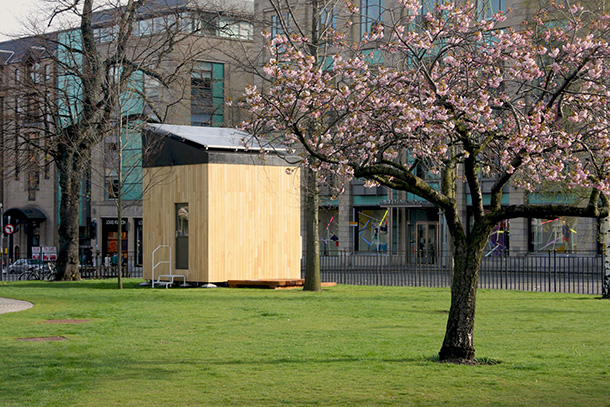
Conceived, designed and managed by Dr Mike Page, engineer and Reader in Cognitive Psychology at the University’s School of Psychology, the first prototype, QB1, was unveiled on April 9, 2011 in St Andrew’s Square, Edinburgh, as a part of the Edinburgh Science Festival.
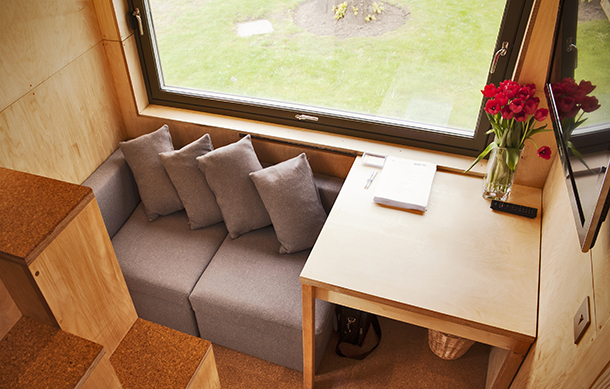
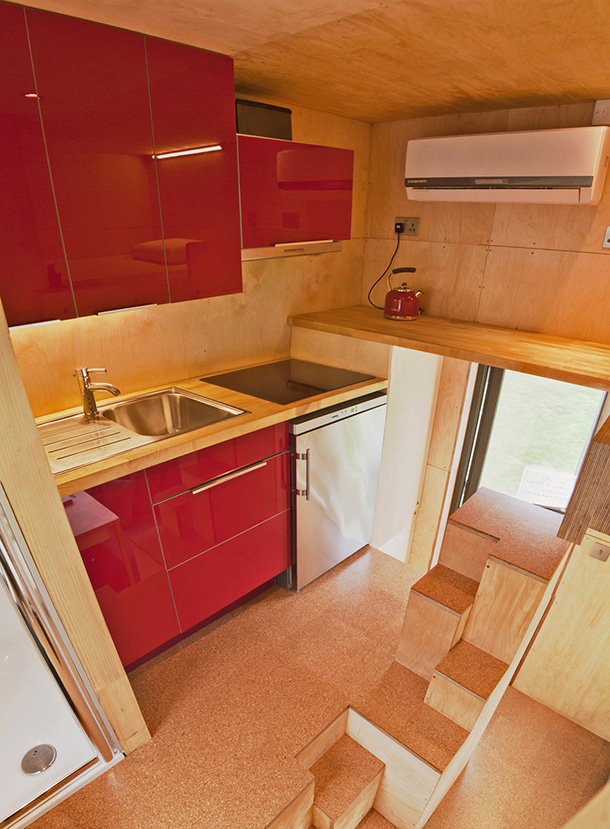
Constructed from a variety of sustainable materials, the Cube provides everything that a single person (or two friendly people) might need. Within its 27 cubic metres it includes a lounge, with a table and two custom-made chairs, a small double bed (120cm wide), a full-size shower, a kitchen (with energy-efficient fridge, induction hob, re-circulating cooker hood, sink/drainer, combination microwave oven and storage cupboards), a washing machine, and a composting toilet. It has cork flooring and there is two-metre head height throughout.
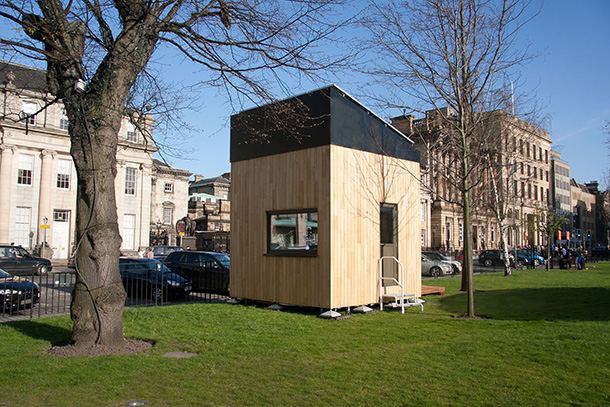
It was an important design criterion that none of the techniques or technologies used in the Cube would be solely applicable to small buildings. When scaled up appropriately, everything could equally well be applied in homes and businesses of all shapes and sizes. The Cube illustrates what the authors believe to be the best of low-carbon living.
The Cube is designed to generate all the energy it needs, averaged over the year. In its ‘home’ configuration, it is equipped with two Mitsubishi PVP 148 solar modules, each around 11 m2 in area and each with a peak power output of 1.48kW. If the Cube were registered with the UK Government’s Feed-in Tariff, then this energy production would raise around ?1000 per year, tax-free, guaranteed and index-linked for 25 years.
The Cube is a well-insulated building, constructed from Kingspan Logic timber-frame elements clad on the outside by FSC-certified English Sweet Chestnut from Vincent Timber and, on the inside, by FSC-certified birch plywood from James Latham plc. There is 140 mm of Kingspan PIR insulation in the walls, 120 mm in the floor and the ceiling, and with Nordan’s NTech triple-glazed Passivhaus windows and door. Space-heating demand will be met by an Ecodan Air-Source Heat Pump (ASHP) from Mitsubishi Electric, linked to a DeLonghi Climaveneta MHD30 fan coil supplied by ICS Heat Pumps.
The Ecodan ASHP will also meet the demand for hot water, stored in a 100-litre pressurized cylinder, designed by Kingspan Hot Water Systems to fit under the shower area. Water use is minimized by the use of Ecocamel low-flow, high-performance showers and taps, so the authors assume a demand for 100 litres of hot water per day, at a temperature of 40 degrees above mains water temperature.
Electrical demand is estimated at around 150W on average, including energy for InterLED Lighting’s high efficiency LED lighting, a low-energy LED TV, an induction hob, a combination microwave oven, an A++ rated fridge, a Paul Ventos 50 heat recovery ventilator, a Berbel Firstline recirculating cooker hood, a Samsung Ecobubble washing machine, and a laptop computer.
The composting toilet was jointly developed with Andy Warren from Natsol Ltd, adapting their standard pedestal to the particular space demands of the Cube. The system separates urine from solid waste, the former mixing with the Cube’s grey water and flowing to a soak-away (probably via a reed-bed), and the latter being composted.
The Cube has bespoke furniture, including two armchairs designed by Mike Page and Linden Davies and constructed from sustainably sourced wood by Ben Whistler Ltd. The upholstery uses a special fabric developed by Camira Fabrics, comprising 75% wool and 25% fibres derived from nettles. The mattress is made from natural latex with an organic cotton cover.
You can enjoy a 360 degree panorama of the interior here.
I want the 6×3 on wheels — pleeez – nice job!
More than enough room. I lived in a 8x8x8 ft cube at Arcosanti for a few months, and it was perfect. lofted bed, 6ft circle windows on all walls except one for door entrance.
Its a beautiful thing everyone should experience living in a compact space to realize how much space is really necessary to be comfortable.
Astoundingly bad.
Setting aside the implications for the unfortunate occupant’s (definitely singular) physical and mental wellbeing, the fact that this engineer chose to dump his monstrosity in the middle of Edinburgh’s New Town speaks volumes for his limited grasp of what architecture and housing are about.
The argument that cramming people in to confined spaces is justifiable in order to save energy (but really it’s about money and profit) has been put forward many times before – always by clients, designers, politicians, bankers and journalists who would never dream of subjecting themselves or their loved ones to such horrendous restrictions.
By all means do experiments with eco-gadgets – all very worthwhile. But don’t use this as an excuse to treat human beings like hamsters.
I was about to write a comment, but Elmo Mac has summed it up well:
“By all means do experiments with eco-gadgets – all very worthwhile. But don’t use this as an excuse to treat human beings like hamsters.”
Why should anyone live in such cramped conditions? This would be step on the road to smaller, cramped conditions becoming a norm. Humans have a limit to what can be tolerated and trying to make such conditions acceptable should not be encouraged. In doing so, it overlooks the real issues. One such issue is of why so many people would attempt to live so close to some centre in the first place.
In addition, it is not correct to use the “environmentally friendly/carbon efficient” argument to justify such an unacceptable dwelling for humans.
The median American house is now at 200 sq meters. How much space does a person need? Ian and Elmo apparently need a large house but many of us would be very comfortable a much smaller space. The earth can not sustain everyone living in large houses. We have to scale back. This is about the future of the earth.
Bill, I’m not advocating obscenely large houses.
My point is that this is not an either/or challenge. It is possible to build homes which conserve resources and which also provide their occupants with decent space standards. This project might do the first but it completely fails in the second.
In terms of architectural and urban qualites – essential ingredients of successful residential design not mentioned here amongst the nettle cushions and hi-tech gadgets – it is a complete disaster.
The Feed in Tarrifs mentioned are currently up in the air, but it’s safe to say that the big energy companies will dictate the price of electricity to owners of such tiny dwellings, so these figures have to be taken with a pinch of salt.
I agree we need better, more environmentally responsible housing design, but this kind of project is just a distraction from the real issues.
I’ve enjoyed living in a variety of countries. I’ve been guested in McMansions and in cardboard shacks. My university dorm I lived in for four years (with a room mate) was smaller than the Cube. I would find it very adequate, even productive for my needs. Great idea and concept. I like the multi-story space manipulation. I’m looking forward to seeing it tastefully decorated for a homey atmosphere.
You can’t even stretch out on the bed… Depressing.